
What your policy covers — and what it does not
Every policy wording is different, and the schedule and endorsements matter as much as the booklet. But across the household and commercial policies sold in Ireland the pattern is consistent enough to say this much:
Usually covered
- Vehicle impact to walls, gates, piers and the building
- Falling trees and branches, including removal
- Falling aerials, dishes and external fixtures
- Structural repair and rebuilding
- Consequential damage to services and finishes
- Making safe and propping
Usually excluded or argued
- Impact by the policyholder's own vehicle, on some policies
- Damage to the tree or the vehicle itself
- Fences and hedges, frequently
- Pre-existing structural movement the insurer can separate out
- Losses below the excess
The line between the two columns is exactly where a claim is won or lost, and it is drawn by the wording, the survey evidence and the argument — not by the insurer’s first letter.
The first 48 hours after impact damage
What is done — and not done — in the first two days decides how much evidence exists later. In order:
Make it safe
A struck wall or pier may be unstable. Keep people away, prop if needed, and get it assessed before anyone leans on it.
Get the other party's details
Vehicle registration, driver, insurer, a Garda reference if they attended. This is your insurer’s route to recovering the cost — and protecting your excess.
Photograph before anything is moved
The vehicle position, the tree, the debris, the crack pattern. The structural argument is made from this.
Do not patch the crack
A repointed crack hides the movement behind it. The assessment has to happen before the repair.
Ring us before the builder
A builder will rebuild the wall. Whether the wall is all that moved is a different question, and it needs answering first.
Notify your own insurer, whoever was at fault
Your policy responds first. Recovery from the other party is your insurer’s job afterwards, and it protects your no-claims position if it is pursued.
How the insurer will assess the claim
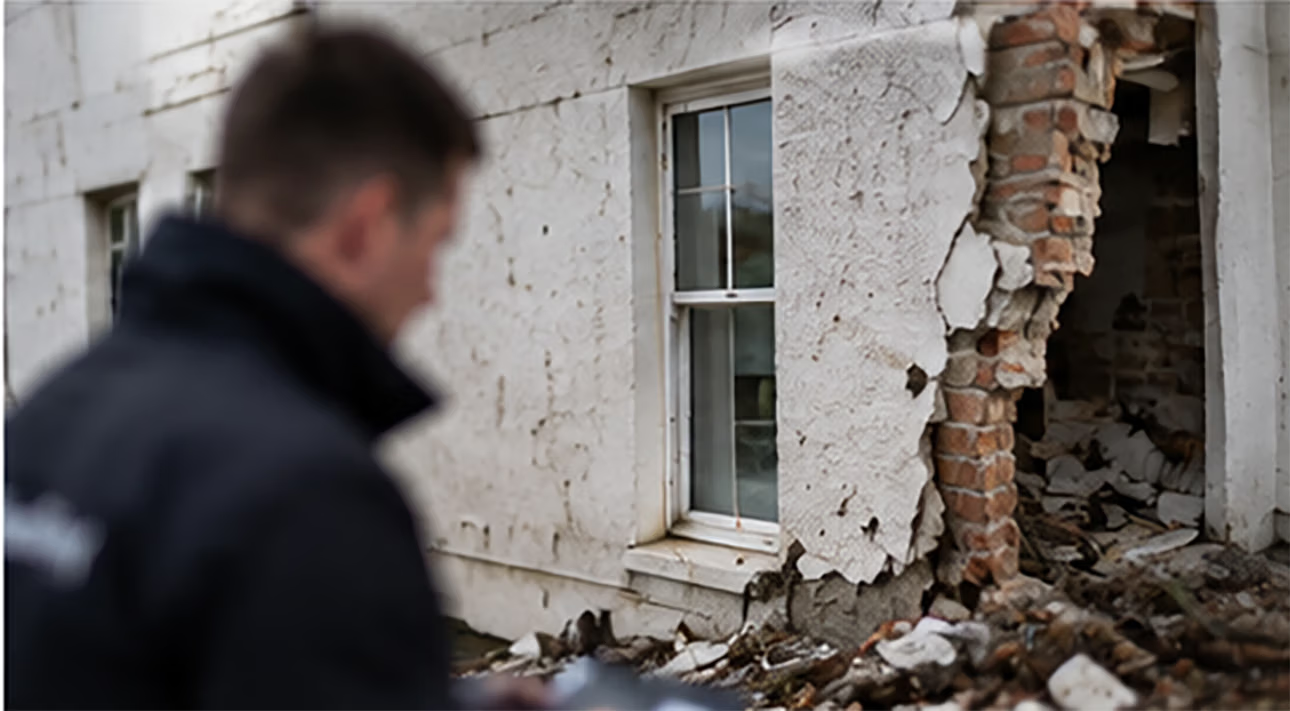
The adjuster will look at the visible damage and price its repair. Impact to a wall, a gable or a pier frequently moves structure without leaving obvious cracks, and a repair that addresses only what is visible leaves the problem in place — to appear as movement a year later, when it is nobody’s claim.
Oisin Mc Carthy holds an honours degree in building surveying, so the assessment of what the impact actually did is made by someone trained to make it. Where another party caused the damage, we put the recovery position to your insurer at the outset, because it affects your excess and your claims history.
Under the Central Bank’s Consumer Protection Code your insurer must keep you informed of developments within 10 working days, tell you its decision within 5 working days of making it, and give written reasons if it does not settle in your favour.
Why impact damage claims get reduced or refused
These are the four positions we meet most often on this type of claim, what each one really means, and how it is answered.
“The crack was already there.”
What it means: The insurer is separating pre-existing movement from the impact.
Our answer: We assess the crack pattern and the structure, and distinguish impact damage from historic movement on the evidence.
“Repoint and repaint.”
What it means: The insurer is pricing a cosmetic repair for a structural loss.
Our answer: Where the impact has moved or destabilised the structure, the scope is the rebuild, and we evidence why.
“Claim off the driver's insurance.”
What it means: The insurer is pushing you to a third party to avoid the claim.
Our answer: Your policy responds first; recovery is your insurer’s job. We keep the claim on your policy and the recovery on the file.
“The fence is not covered.”
What it means: Frequently true — but gates, piers and walls often are.
Our answer: We claim what the policy covers and tell you plainly what it does not.
If the insurer’s final response is wrong, the complaint goes to the Financial Services and Pensions Ombudsman — free to you, and taken more seriously when the claim file is already properly documented.
What a proper settlement includes
A settlement is a schedule of every head of loss the policy responds to, priced at what it will actually cost to put right — not the first figure offered. On a claim like this that schedule should cover:
- Making safe, propping and securing
- Structural assessment
- Rebuilding walls, piers, gates and railings
- Structural repair to the building where struck
- Consequential damage to services, finishes and contents
- Debris and tree removal
- Redecoration and reinstatement of surfaces
- Recovery from the responsible party, pursued by your insurer
Our fee. No charge for the initial consultation. Our standard fee is 10% + V.A.T. of the settlement agreed, with a minimum fee explained before any work starts. The fee is agreed with you before any work begins.
Impact damage claims across Louth, Meath, Monaghan, Cavan and Dublin
We work from two offices — Irish Grange, Carlingford, Co. Louth and Main Street, Blanchardstown, Dublin — and we are on site fastest across Louth (Dundalk, Drogheda, Ardee, Carlingford), Meath, Monaghan, Cavan, Dublin (Swords, Blanchardstown) and Kildare.
Vehicle impact on boundary walls and piers along the N52, the R132 and the rural roads of Louth, Meath and Monaghan is the impact claim we see most — and fallen trees after Storm Éowyn and Storm Chandra the second.
Outside those counties, ring us anyway — on a serious claim the survey and the policy argument matter far more than the drive. Every area we cover.